

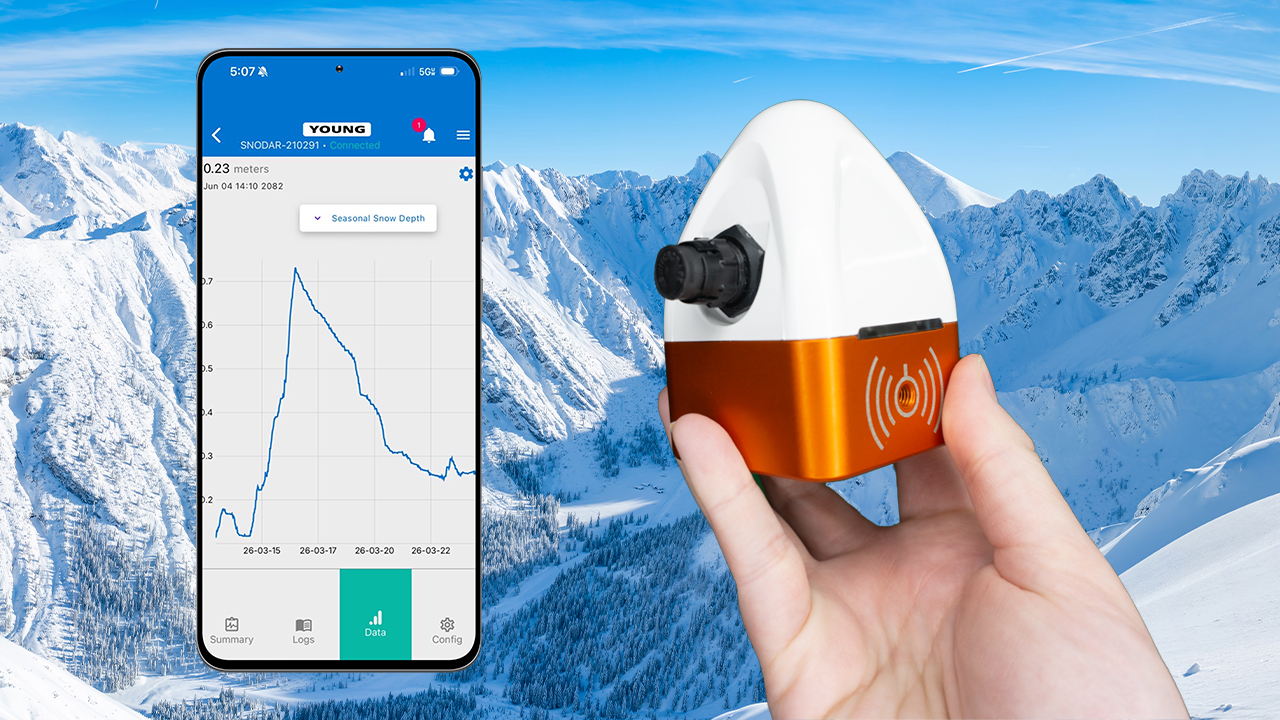
SNOdar just got better. R.M. Young’s engineering team took customer feedback seriously, overhauling the app, improving SDI-12 reliability, and refining the hardware. In this webinar, we’re walking through exactly what changed, why it matters, and how a LiDAR-based sensor this compact and this low-power holds up when conditions are at their worst.
In this webinar, we walk through:
- Why LiDAR outperforms ultrasonic sensors in storm conditions — and what that means for your data
- SNOdar’s full measurement capabilities: snow depth, daily new snowfall, seasonal accumulation, and sensor orientation monitoring
- What was rebuilt and why — the overhauled app, enhanced SDI-12 reliability, redesigned mounting clamp, and updated firmware
- How to connect a sensor to the app on your phone and get to live data in under 2 minutes
- Hardware specs, power requirements, and deployment best practices for remote winter environments
- SDI-12, RS-232, and Bluetooth connectivity — how SNOdar integrates into networks you already run
- Real-world application scenarios across avalanche forecasting, DOT, ski resort ops, SNOTEL, and scientific monitoring
If you’re responsible for snow monitoring infrastructure—whether that’s a remote SNOTEL site, a DOT network, or an avalanche forecasting operation, this session gives you everything you need to evaluate, deploy, and get the most out of SNOdar.