

Snow depth measurement is a well-established problem with two dominant sensing technologies: ultrasonic and LiDAR. Under calm conditions, both produce reliable data. The distinction becomes operationally significant during active precipitation, precisely when accurate snow depth data has the highest value.
This blog post breaks down how each technology works, where ultrasonic sensing fails under storm conditions and why, and what that difference means for networks where real-time data during an event is operationally critical. It also covers the trade-offs involved in choosing between the two: cost, deployment context, and application requirements, so that engineers and network operators can make an informed decision based on technical reality rather than marketing claims. Field evidence from the Northwest Avalanche Center, operating across some of the most demanding winter terrain in the country, illustrates what that performance gap looks like in practice.
Prefer to watch? Skip to the video.
How Ultrasonic Sensors Measure Snow
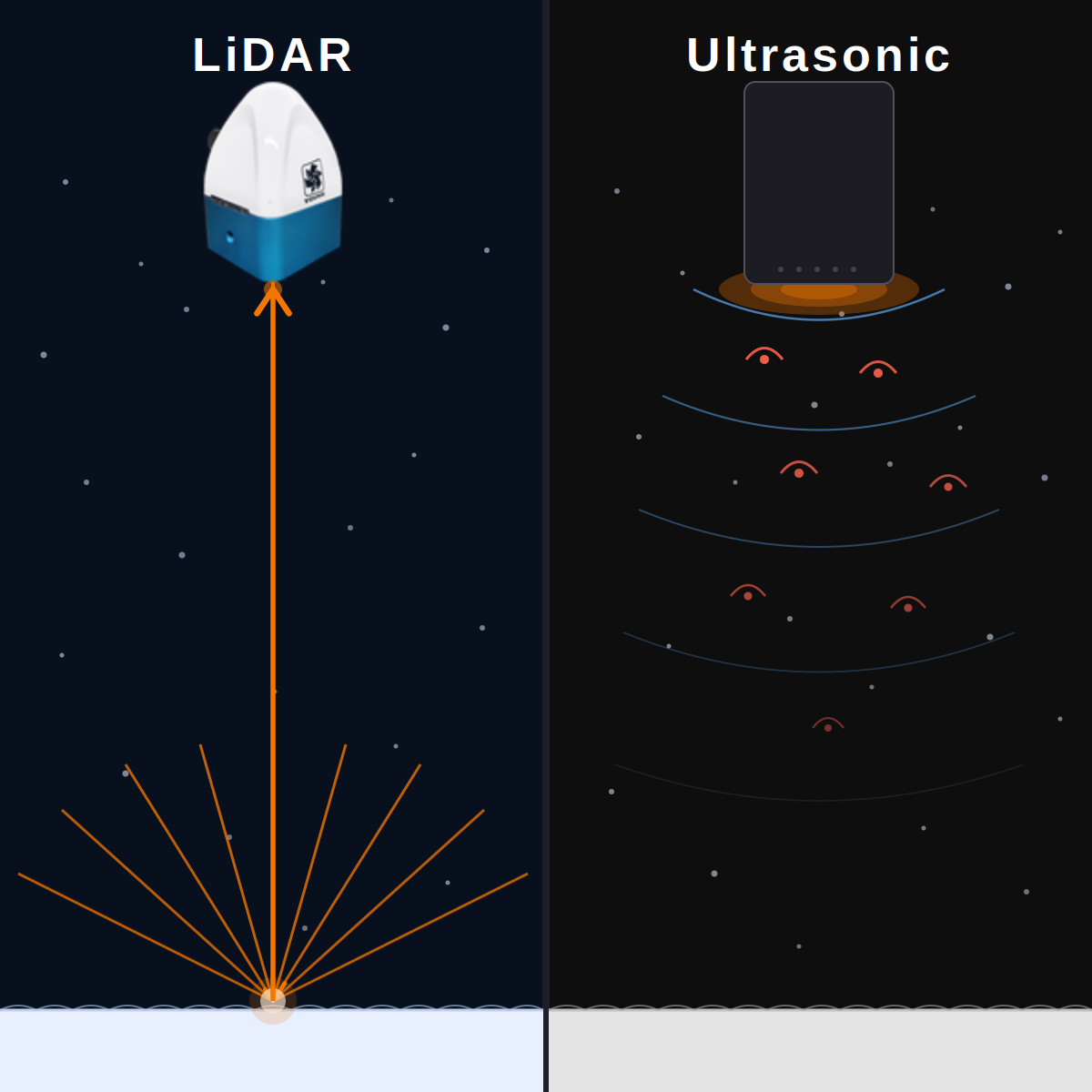
Ultrasonic sensors emit a broadband acoustic pulse and calculate distance based on time-of-flight of the return echo. The measurement relies on a stable acoustic path between the sensor and the snow surface.
The fundamental limitation is the air column itself. In active snowfall, falling precipitation, blowing snow, and vertical temperature gradients scatter and attenuate the acoustic signal before it reaches the ground. The result is a degraded return: increased noise, erratic readings, and in severe conditions, complete signal dropout. This is not a calibration problem. It is a physical constraint of acoustic sensing in a disturbed medium. No firmware update or signal processing improvement resolves it.
For networks that depend on storm-period data, this creates a consistent operational burden: post-event data cleaning, gap-filling, and retrospective interpretation of records that should have been real-time.
How LiDAR Is Different
LiDAR sensors emit a narrow, collimated pulse of infrared light and calculate range from the return time of reflected photons. SNOdar operates at a wavelength at which snow and bare ground are both highly reflective, producing a strong, consistent return signal from the surface.
The key distinction is interaction with the intervening air column. Falling snow does not meaningfully scatter infrared light at LiDAR wavelengths the way it scatters acoustic energy. The beam transits the air column, reflects off the snow surface, and returns reliably, whether conditions are clear or in the middle of a heavy snowfall event. Accuracy is ±1 cm to 2 m, ±2 cm to 4 m, and ±4 cm to 8 m, with 1 cm resolution across a 0.09 to 9 m measurement range. Those specifications hold in storm conditions the same as they do in calm ones.
What This Means in Practice
The Northwest Avalanche Center operates across the Cascades from Mount Hood north to the Canadian border, covering some of the most challenging winter terrain in the lower 48. They have reported that SNOdar has far exceeded the reliability of any other sensors in their network during storm periods. For organizations in avalanche forecasting, DOT operations, and SNOTEL-adjacent monitoring, that distinction is material.
Real-time storm data that can be trusted changes what decisions are possible. Road closure thresholds can be based on current measurements rather than extrapolated trends. Snowpack accumulation rates can be tracked as they develop. Grooming and snowmaking decisions do not have to be made on interpolated or manually patched records.
The downstream effect of unreliable storm data extends beyond the storm window. When operators learn their sensors underperform during events, they discount the data network-wide. Stations that consistently fail during events represent a recurring maintenance and credibility liability.
The Practical Trade-off
Ultrasonic sensors remain appropriate for applications where storm-period accuracy is not a primary requirement. They are cost-effective, widely supported, and perform well under stable atmospheric conditions. For networks where the critical measurement window falls outside of active precipitation, they remain a technically sound choice.
For applications where the measurement must be accurate during the event, including avalanche forecasting, DOT real-time operations, and hydrological monitoring during accumulation periods, LiDAR-based sensing is the more technically defensible approach. The physics are better suited to the task.
Hear From Our Engineering Manager
In this clip from our recent webinar, Engineering Manager Conor Byrne walks through how LiDAR works and what sets it apart from ultrasonic technology.