

High mountain regions play a critical role in global water resources, yet they remain among the least observed environments on Earth. Extreme winds, low air density, intense cold, and limited access make long-term weather monitoring exceptionally difficult, leaving significant gaps in understanding how climate variability and change are affecting snow, ice, and downstream water availability. In the central Andes of Argentina, these challenges are especially pronounced, despite the region’s importance as a water source for millions of people.
A recent collaborative effort on Aconcagua, the highest mountain in the Americas, sought to address this gap by establishing a high-elevation weather station network capable of delivering continuous, high-quality observations under some of the most extreme conditions on the planet. The project was led by Baker Perry, Professor of Climatology and Nevada State Climatologist at the University of Nevada, Reno, in partnership with Argentine research institutions and international collaborators, including R.M. Young Company.
Be sure to watch our full interview with Baker Perry.
Scientific Motivation and Regional Importance
The Aconcagua Weather Station Network, known as the Wayra project—named for the Quechua word for wind—was designed to capture the atmospheric processes driving snow accumulation, redistribution, and loss across a vertical transect of the mountain. These processes are central to understanding glacier mass balance and seasonal water availability in a region already experiencing prolonged drought.
Meltwater and seasonal snowpack from the high Andes supply major population centers, including Mendoza, Argentina, and Santiago, Chile. Yet direct observations from the upper elevations of the Andes have historically been sparse, forcing scientists to rely heavily on models with limited validation. The Wayra network was conceived to provide the observational backbone needed to better understand how large-scale circulation patterns, local wind regimes, and climate trends interact to shape water resources far downstream.
A Network Designed for Vertical Insight
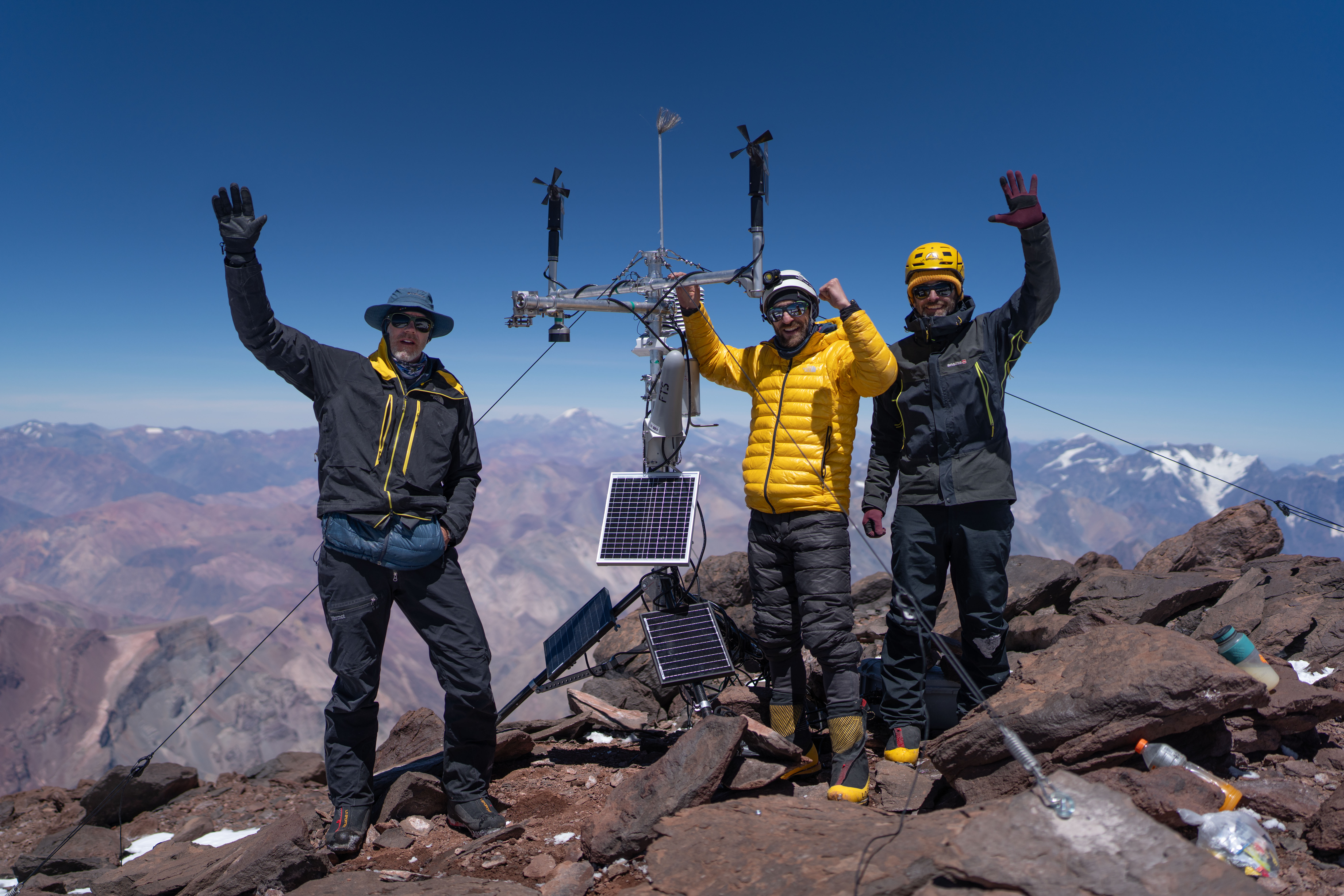
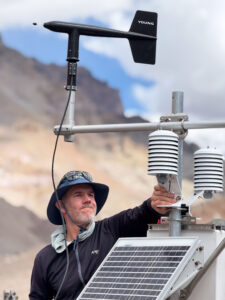
The project consists of five weather stations spanning elevations from approximately 14,000 feet to just below 23,000 feet. Two stations near base camp focus on precipitation and surface energy exchange, including detailed measurements of sublimation versus melt on glacier surfaces. A comprehensive station at Camp Two captures wind, temperature, radiation, and precipitation, while a simplified but highly resilient installation near the summit focuses on core atmospheric variables. A fifth station on the eastern side of the mountain completes the transect, providing insight into how weather systems evolve as they cross the range.
This vertical and cross-mountain configuration allows researchers to observe how storms move through the Andes, how wind redistributes snowfall, and how conditions vary dramatically over relatively short distances. These observations are particularly valuable for improving weather and climate models in complex terrain.
Wind as a Driver of Snow and Water Loss
Wind is a central focus of the Wayra project, both scientifically and operationally. In the central Andes, wind governs storm trajectories, redistributes snowfall, and accelerates snow and ice loss through sublimation. In cold, dry environments such as Aconcagua, a significant portion of snow loss occurs directly to the atmosphere rather than through meltwater runoff.
High-quality wind measurements from multiple elevations are therefore essential for understanding how much snow ultimately contributes to seasonal water supplies. These data also support climber safety by improving forecasts of hazardous conditions, particularly during summit attempts when exposure is greatest.

Selecting Instrumentation for Extreme Conditions
Choosing instrumentation capable of surviving these conditions was a critical component of the project. Perry and his collaborators drew on decades of experience deploying sensors in extreme environments, including long-standing work with wind monitoring instruments manufactured by R.M. Young Company.
Perry has previously partnered with R.M. Young on installations in the Andes, the Appalachian Mountains, and on Mount Everest, where similar challenges of high wind, severe cold, and limited maintenance access exist. These prior deployments demonstrated the durability, accuracy, and low power requirements of the instruments, making them well suited for Aconcagua’s demanding environment.
“I have a long history of working with R.M. Young wind monitors on mountain sites around the world. Their products are extremely robust and have brought back critical data from some of the most hard-to-reach locations, which makes them an invaluable partner for high-elevation climate research,” stated Perry.
Beyond performance, the collaboration extended into design considerations. Feedback from high-altitude deployments informed modifications aimed at improving survivability under extreme wind loading and ice accretion. For Perry’s team, these environments serve as real-world testing grounds that cannot be replicated in laboratory settings, providing valuable insight into long-term instrument behavior under sustained stress.

Installation at the Limits of Human Performance
Installing weather stations at nearly 23,000 feet introduces logistical and physiological constraints far beyond those encountered at conventional sites. Installation teams operate without supplemental oxygen and typically have only a few hours at the summit to complete all work before descending. Every component must be carried by climbers and high-altitude porters, placing strict limits on weight and requiring extensive pre-planning.
Unlike lower-elevation installations, there is no opportunity for on-site troubleshooting. All wiring and sensor configurations must be finalized ahead of time, and installation procedures are rehearsed repeatedly at base camp. Cold temperatures and heavy gloves eliminate fine motor control, making pre-wired and pre-configured systems essential.
Once installed, teams must confirm satellite transmission before leaving the site. Given the narrow seasonal access window, failure to verify operation can mean waiting months for another opportunity to diagnose or repair a problem.
Maintaining Stations with Narrow Access Windows
Seasonal access further complicates long-term maintenance. On Aconcagua, meaningful access is typically limited to a short window between December and February. Outside that period, weather conditions and the absence of infrastructure make site visits impossible.
These constraints were on full display during the network’s first full year of operation. When transmission from the summit station ceased during the austral winter, the team could not confirm the cause until climbers reached the site months later. Photographs revealed that the GOES satellite transmitter had been knocked off, almost certainly by extreme winds. Once identified, the team had a narrow window to source replacement components, navigate international shipping and customs logistics, and plan a maintenance expedition before the climbing season ended.
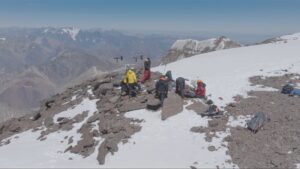
Perry returned in late February 2026 alongside IANIGLA (Instituto Argentino de Nivología, Glaciología y Ciencias Ambientales) researchers Mariano Castro and Pierre Pitte. The expedition was demanding—persistent high winds, extreme cold, a compressed schedule, and minimal logistical support above Base Camp tested the team at every stage. With poor weather dominating the month, Perry, Castro, and Pitte were among the very few teams to reach the summit at all. Departing from Camp 2 rather than the standard Camp 3 and carrying full loads, they reached the summit station at 22,769 ft (6,940 m), replaced the transmitter, and upgraded several sensors to keep the station in optimal condition ahead of another year of observations.
While the summit team was on the upper mountain, IANIGLA researchers Mari Carreas and Ivanna Pecker completed a separate but equally demanding task at Nido de Condores (Camp 2, 18,110 ft / 5,520 m): installing a double alter shield around the precipitation gauge. This shield is essential for minimizing undercatch of solid precipitation and improving the accuracy of snowfall records from the network. Installation required digging 12 anchor holes roughly 50 cm deep through permafrost using a barreta—a heavy digging bar—a formidable effort at altitude. Carreas and Pecker did the bulk of the work and completed the erection of the shield before the summit team returned.
These constraints underscore the importance of robust instrumentation and strong partnerships, as both planning and execution must occur under tight timelines with little margin for error.
Early Results and Broader Impact
Despite these challenges, the Wayra network has already begun delivering valuable insights. Preliminary data show sustained wind speeds exceeding 100 miles per hour during major storm events, with significant variability tied to elevation and storm direction. These observations are being used to refine weather and climate models by correcting known biases in wind and temperature forecasts over complex terrain.
The data also serve practical safety applications. Real-time observations, when transmission is active, are shared publicly through Argentine research partners, supporting climbers, guides, expedition operators, and park authorities. Even when real-time data are unavailable, archived observations continue to improve statistical relationships used to enhance forecasts.
Advancing Climate Science Through Collaboration
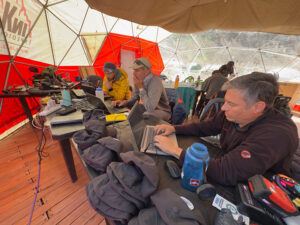
For Perry, the significance of the project extends beyond Aconcagua itself. High mountain snow and ice function as natural water reservoirs, releasing water gradually throughout the year. As climate patterns shift, changes in wind, precipitation phase, and sublimation rates can dramatically alter water availability.
Direct measurements from extreme environments are essential for improving projections of future water resources. The Wayra project demonstrates how sustained collaboration between researchers and instrumentation manufacturers can expand observational capacity, strengthen climate records, and improve understanding of Earth’s most critical water towers.
As additional years of data are collected, the Aconcagua Weather Station Network is expected to become an increasingly valuable reference point for both climate science and operational forecasting, helping bridge the gap between remote mountain environments and the communities that depend on them.
What Comes Next
The network’s first full year of data is now being analyzed, with several scientific papers in preparation on key findings. Real-time data from across the network are publicly available through the Observatorio Andino at https://observatorioandino.com/estaciones/ (select Sector Parque Aconcagua).
Looking ahead, Perry and his team will return to Mount Everest in April to carry out scheduled maintenance and upgrades on the high-elevation weather stations installed as part of earlier expeditions. As on Aconcagua, these efforts are focused on extending the operational life of the stations, preserving continuity in the climate record, and maintaining real-time observational capabilities that support both scientific research and climber safety.
Together, the continued work on Aconcagua and Everest reflects a long-term commitment to building and maintaining high-quality observational networks in some of the world’s most extreme environments. Each expedition adds not only new data, but also valuable insight into how instrumentation performs under sustained stress, informing future deployments and advancing the broader understanding of high mountain weather and climate processes.
We are proud to play a role in the Wayra project and the critical scientific work it supports. Delivering reliable data from one of the world’s most extreme environments—year after year, through conditions that push instrumentation to its limits—is exactly the kind of challenge we build for. The work Baker Perry and his collaborators are doing on Aconcagua matters far beyond the mountain itself, and we are honored to be part of it.
This article has been adapted from its original publication in Meteorological Technology International, April 2026.