

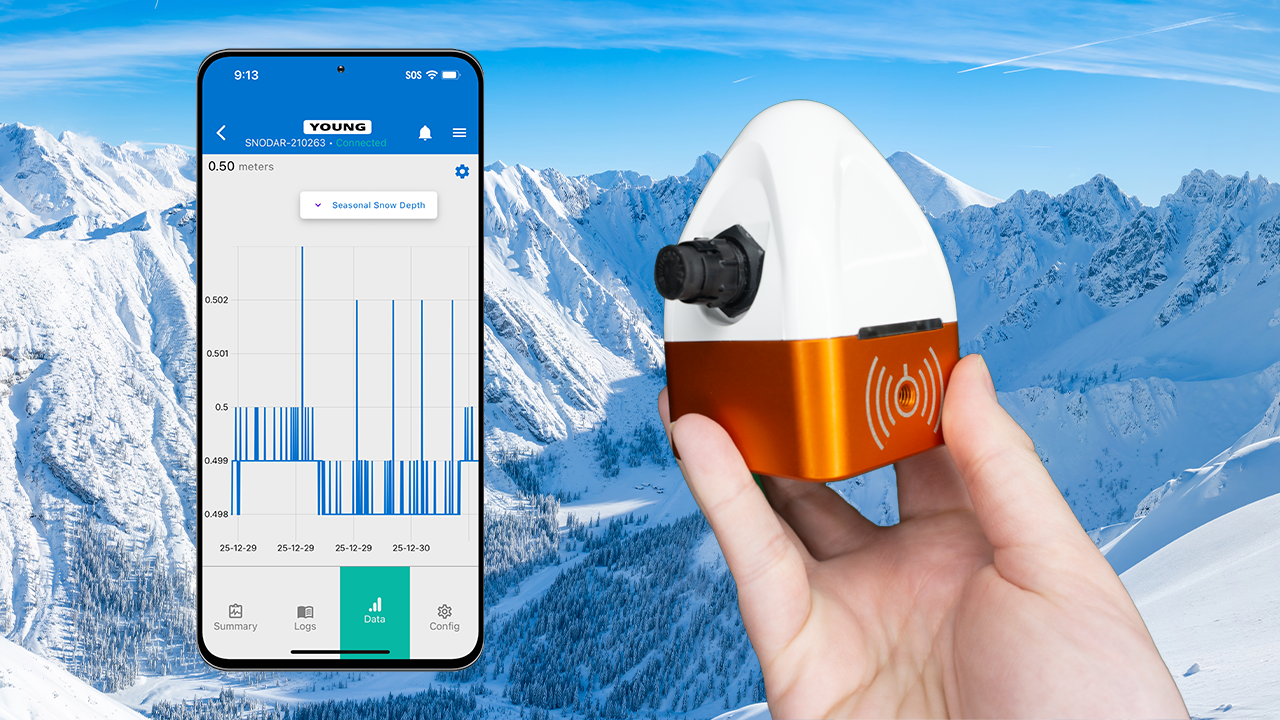
Accurate snow depth data is a critical input for a wide range of industries, from avalanche forecasting and SNOTEL monitoring to DOT road management, ski resort operations, and scientific research. Getting that data reliably, especially during active storm events, has long presented a technical challenge. The SNOdar (Model 54000) was designed to meet that challenge, and today’s relaunch represents a significant step forward in delivering on that promise.
Below, we walk through how SNOdar works, what makes it different, and what has been updated in this release.
What Is New With SNOdar?
SNOdar is a LIDAR-based snow depth sensor designed to deliver real-time, accurate measurements even in the middle of a snowstorm. Unlike ultrasonic sensors, which use sound waves that scatter off of falling precipitation, SNOdar uses the time of flight of an infrared laser pulse to measure the distance to the snow surface with negligible interference from falling precipitation. The result is precise, stable depth data that holds up when conditions are at their worst.
Beyond the measurement technology, SNOdar is built for practical field deployment. At 265 grams and roughly the size of a baseball, it is one of the most compact laser-based snow depth sensors available. It draws an average of 0.5 watts, making it well suited for solar and battery-powered remote sites. It stores a full season of data on an internal non-volatile logger, eliminating the need for a separate logger at each site. And it configures entirely from a free iOS or Android app over Bluetooth, with no cable or laptop required.
We listened to your feedback and poured countless engineering hours improving the user experience of SNOdar on every level, overhauling the app, hardware, outputs, and more. Here’s what’s new with the SNOdar relaunch:
1. App Overhaul
The SNOdar mobile app has been significantly redesigned. The interface is cleaner, performance is faster, and plotting capacity now supports up to 10,000 measurements.
These improvements benefit users in two key ways:
- Faster, more reliable setup and calibration in the field
- Easier data review and interpretation back in the office
2. Enhanced SDI-12 Reliability
Firmware updates have addressed consistency issues in the SDI-12 data output, delivering cleaner and more stable readings when SNOdar is connected to external data loggers.
For users integrating SNOdar into existing hydrological or meteorological monitoring networks, this means:
- More reliable data transfer to third-party loggers and platforms
- Fewer integration issues in multi-sensor network configurations
SDI-12 v1.4 and RS-232 outputs allow SNOdar to connect to existing infrastructure without requiring new equipment.
3. Improved Data Visualization
Parameter display has been refined and date axis rendering has been corrected within the app.
- Data logs are more accurate to read across extended time periods
- Trends are easier to identify and interpret at a glance
4. Redesigned Mounting Clamp
The mounting clamp has been updated to accommodate a wider range of tower sizes. Improved thermal isolation between the clamp and sensor body helps protect measurement integrity in extreme cold, where heat transfer from the mounting structure can increase the load on the internal heater.
- More universal fit across common tower configurations
- Better performance in the low-temperature environments where SNOdar is most often deployed
5. Updated Specifications
The full specification sheet has been updated to reflect the current hardware and firmware. Users and integrators should reference the latest version for accurate technical details. It can be found on the product page and in the manual.
How SNOdar Compares
Not all snow depth sensors are created equal. Here is how SNOdar stands apart from the two most common alternatives on the market.
Compared to ultrasonic sensors:
- LIDAR maintains accuracy during active snowfall; ultrasonic signals scatter in falling precipitation, degrading data quality exactly when it matters most
- SNOdar stores a full season of data internally; most ultrasonic sensors require a separate data logger at each site
- App-based setup over Bluetooth means no cable, no laptop, and no specialist required in the field
Compared to large-format laser sensors:
- SNOdar is 9x smaller and a fraction of the weight, making it far easier to mount, ship, and deploy
- At 0.5W average draw, SNOdar is designed for solar and battery-powered remote sites; large-format lasers require significant power to run onboard heaters that prevent lens icing
- SNOdar is available at $1,699, compared to $3,000 or more for comparable large-format laser options. Factor in the eliminated per-site logger cost and the value gap widens further.
- Automatic compensation for the calculated depth at oblique mounting up to 30 degrees from normal provides flexibility for hillside sites and non-standard tower configurations
What This Means for Your Application
The combination of LIDAR accuracy, ultra-low power consumption, a built-in seasonal data logger, and app-based configuration makes SNOdar a strong fit for a wide range of monitoring applications. The improvements in this release strengthen the reliability and usability of the platform across all of them.
Whether you are deploying at a SNOTEL station, a ski resort, a remote research site, or a DOT monitoring location, SNOdar is built to deliver data you can depend on, including when it is actively snowing.
If you have questions about whether SNOdar is the right fit for your application, our team is happy to help.
Join Us for a Live SNOdar Webinar
Want to go deeper? We are hosting a live webinar to walk through SNOdar in detail, including how it works, what has changed in this release, and how it fits into a range of monitoring applications. It is a great opportunity to see the sensor and app in action, ask questions directly, and get a better sense of whether SNOdar is the right fit for your needs.
The webinar is open to all, whether you are a current customer, evaluating options, or simply curious about where LIDAR-based snow depth monitoring is headed. We would love to have you there.
Available Now
SNOdar (Model 54000) is available now. It ships within one week and is backed by a full one-year warranty.