

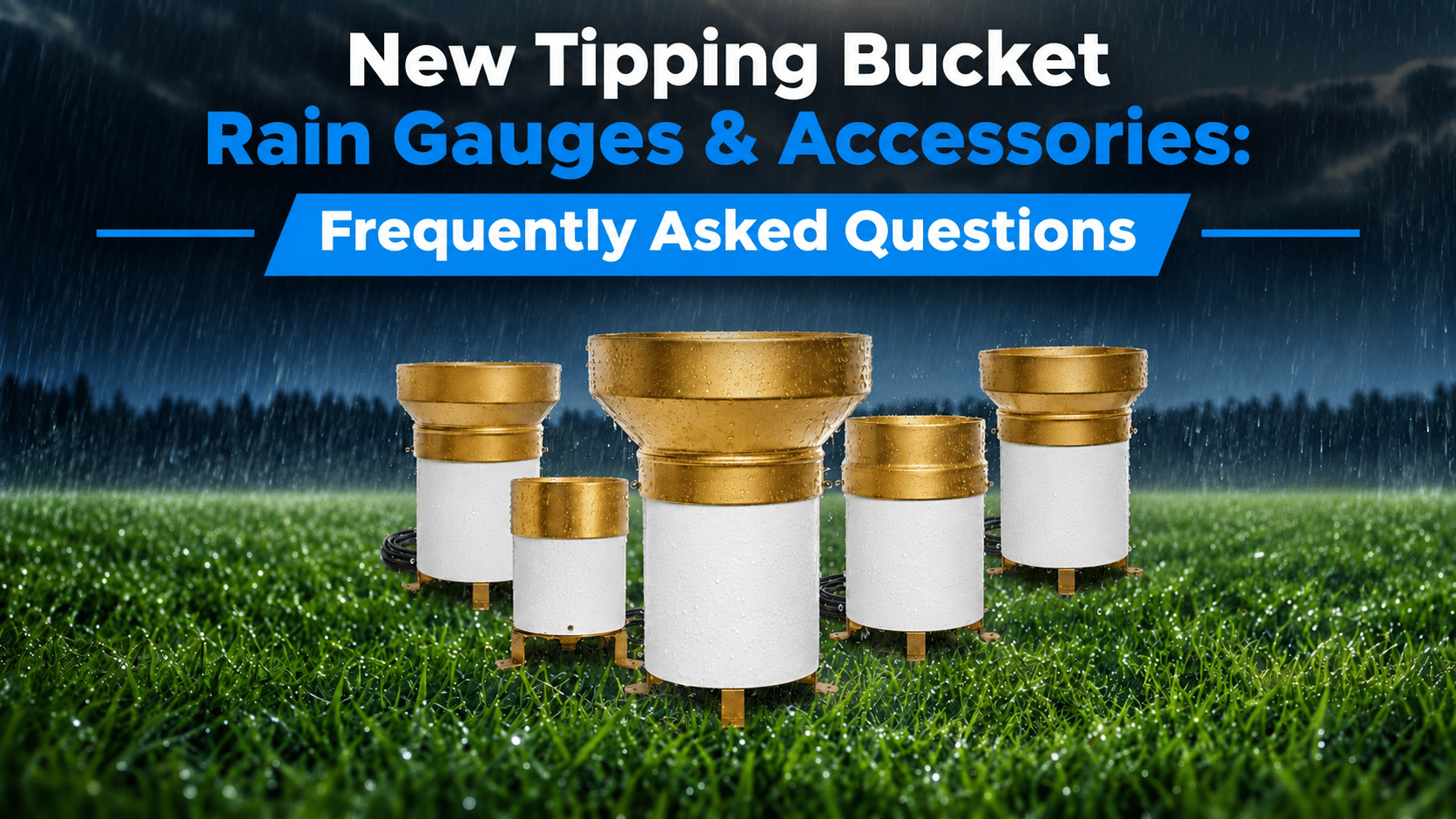
We know, we know… so many new options to choose from! It can be a bit overwhelming, so we thought we’d put together a little FAQ to help you choose! We’re always here to answer any questions you may have along the way.
Jump to:
Choosing a Gauge
The Siphon Option
Configuration Options
Accessories
Maintenance & Support
Ordering
Choosing a Gauge
What tipping bucket rain gauges are available?
We now offer five TE tipping bucket rain gauge models, alongside our established 52202 and 52203 gauges:
| Model | Collector Size | Calibration | Accuracy | Best For |
|---|---|---|---|---|
| TR-4 | 100 mm (4″) | 0.01 in per tip | ±2% up to 25 mm/hr | Budget deployments and compact installations |
| TR-525I | 154 mm (6″) | 0.01 in or 0.2 mm per tip | ±1% up to 50 mm/hr | Versatile, general-purpose monitoring |
| 52202 / 52203 | 160 mm (6.3″) | 0.1 mm per tip | ±2% up to 25 mm/hr | Networks that follow WMO requirements |
| TR-525-W2 | 200 mm (7.9″) | 0.1 mm, 0.2 mm, or 0.01 in per tip | ±1% up to 50 mm/hr | Metric networks built around a 200 mm collector |
| TR-525USW | 203 mm (8″) | 0.01 in or 0.2 mm per tip | ±1% up to 50 mm/hr | Networks that follow the 8-inch standard, including National Weather Service requirements |
| TR-525M | 245 mm (9.66″) | 0.1 mm per tip | ±1% up to 50 mm/hr | High-catch metric installations |
How do I choose the right collector size?
Start with your network’s standard. If your existing gauges or reporting requirements specify a collector size, match it, so your new data stays comparable with your historical records. If you don’t have a set standard, the TR-525I is a versatile starting point, and the TR-4 is a good fit for budget deployments.
Which calibration should I choose?
Choose the calibration that matches your existing records and reporting units. Networks that report in inches typically use 0.01 in per tip. Metric networks typically use 0.1 mm or 0.2 mm per tip. Calibration options vary by model, so check the table above.
Why do accuracy ratings differ between models?
Accuracy depends on collector size and bucket design. The standard TR-525 models are rated ±1% up to 50 mm per hour. The compact TR-4 is rated ±2% up to 25 mm per hour, making it a cost-effective option where research-grade accuracy isn’t required.
The Siphon Option
What does the siphon option do?
In extremely heavy rain, standard tipping bucket gauges can undercount, because water keeps arriving while the bucket is tipping. A siphon controls the flow of collected water into the bucket, so it fills and tips at a steady rate. Siphon versions stay accurate up to 508 mm per hour, about 10 times the accurate range of a standard gauge.
When do I need a siphon?
Consider the siphon if your sites regularly see intense rainfall, such as flood warning networks, hydrology and stormwater monitoring, or sites in tropical and monsoon regions.
When is a standard gauge the better choice?
At lower rainfall rates, standard models are more accurate: ±1% up to 50 mm per hour, compared with ±2% up to 254 mm per hour and ±3% up to 508 mm per hour for siphon versions. If your sites rarely see intense rain, a standard gauge is likely the better fit.
Which models offer a siphon?
All four TR-525 models: the TR-525I, TR-525-W2, TR-525USW, and TR-525M. The siphon isn’t available on the TR-4.
Configuration Options
What pivot options are available?
TR-525 gauges come with brass pivots as standard, with sapphire jewel pivots available as an upgrade for long-term consistency.
What’s the difference between a single and dual reed switch?
A single reed switch provides one pulse output, which works for most installations. A dual reed switch provides two independent outputs, so you can connect the gauge to two data systems or build in redundancy.
What output options are available?
- Standard: Reed switch pulse output with a 10 ft cable.
- 4–20 mA output: For systems that require an analog current signal.
- Internal pendant logger: Records rainfall inside the gauge, for standalone sites.
- External pendant logger: Records rainfall in a separate logger connected to the gauge.
- USB pendant logger: A logger with a USB cable for easy data download.
- No cable: A bare terminal block, for custom wiring.
Will the gauges work with my existing data logger?
Yes. The standard reed switch pulse output works with virtually any data acquisition system.
What mounting options are available?
TR-525 gauges come standard with mounting feet for installation on a firm, level platform. For pole mounting, the MB-525 pole mounting base is available in 1.00″ NPT and 1.25″ NPT versions.
Accessories
What accessories are available, and which gauges do they fit?
| Accessory | What It Does | Compatible With |
|---|---|---|
| HT-525 Heater (120 VAC) | Keeps the gauge working through snow and freezing rain | All TR-525 models |
| MB-525 Pole Mounting Base | Mounts the gauge on a pole (1.00″ or 1.25″ NPT) | All TR-525 models |
| FC-500 Field Calibration Kit | Verifies calibration on site, with no return shipping | All models |
| BB-525 Bird Repellent | Keeps birds from perching on and fouling the collector | All models |
| Additional Cable | Extends the standard 10 ft cable for longer runs | All models |
Do I need a heater?
If your site sees snow or freezing rain, a heater keeps the gauge clear so precipitation is measured as it falls instead of freezing in the collector. The HT-525 runs on 120 VAC. For sites with a 230 V supply, the heated 52202 is also available.
Can I add a heater to a gauge I already own?
Yes. The HT-525 can be added to any TR-525 series gauge, and installation instructions and hardware are included. If you order the heater with a new gauge, it’s installed for you.
Do I need the bird repellent?
If birds are common at your site, yes. Birds perching on the collector can block water flow and foul it with debris, affecting your readings.
Maintenance and Support
How much maintenance do the gauges need?
Very little. Clean debris from the filter screen regularly and verify calibration periodically with the FC-500 field calibration kit. Water drains out of the gauge automatically, so there’s nothing to empty. In snow or freezing rain, remove the debris screen on heated gauges to prevent ice from bridging over the collector.
What’s the warranty?
Three years.
Ordering
How do I order?
Contact our team at [email protected] or +1 (231) 946-3980, or reach out to your local R.M. Young distributor. Our team will walk you through each option to make sure your gauge is configured exactly the way you need it. Existing TE customers can also continue ordering through texaselectronics.com.
Existing TE customer? See our acquisition FAQ.