

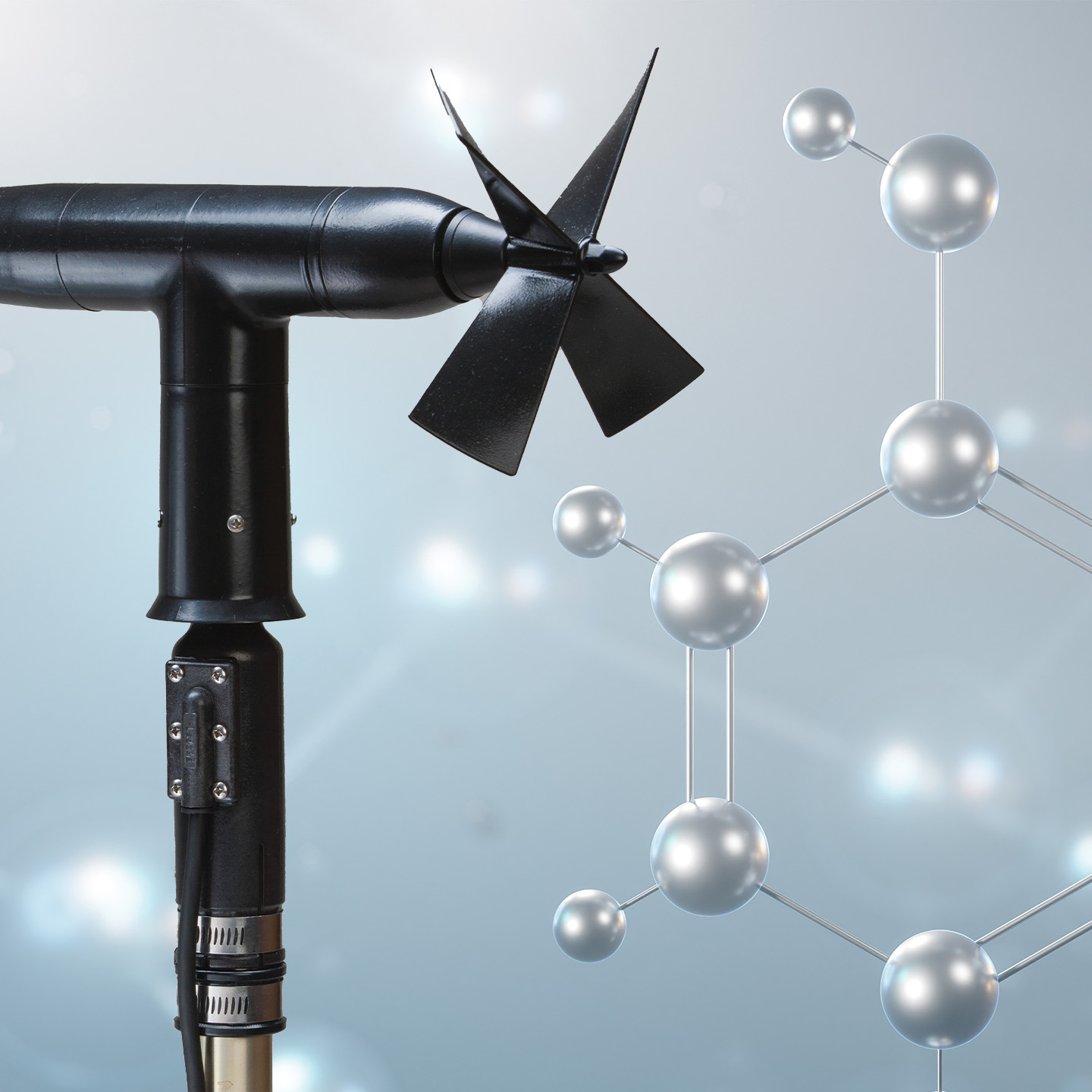
At R.M. Young Company, our instruments are designed to perform in some of the harshest environments on Earth. But even the best designs can be pushed to their limits—especially when installed on Mount Everest.
After our first Everest deployment of the Alpine Wind Monitor (Model 05108-45), we saw how extreme alpine conditions—violent winds, sub-zero temperatures, and airborne debris—can cause serious damage to sensitive components like the propeller. That experience sparked a mission: find a better material that could withstand the summit.
Introducing Polycarbonate: Built for Impact
We’re always striving to produce the highest quality, most rugged instruments on the market, so this weakness needed to be addressed. We concluded that it was time to upgrade the propeller.
After extensive testing and research, we landed on polycarbonate, a high-performance thermoplastic known for its exceptional impact resistance, toughness, and durability. Unlike traditional plastics, polycarbonate doesn’t crack under pressure. It bends, absorbs impact, and keeps going. This makes it ideal for high-altitude applications where flying ice, gravel, or other debris can strike the sensor at high speeds.
Compared to the previous material, polycarbonate offers dramatically improved performance. It delivers up to 250 times the impact resistance of glass, making it far more resilient to flying debris and harsh conditions. With a tensile strength of up to 70 MPa, it maintains structural integrity under stress, while its dimensional stability in cold climates ensures reliable operation even in freezing temperatures. When properly treated, polycarbonate also resists UV degradation, and its lightweight nature allows for durable performance without adding unnecessary mass to the sensor.
The Science Behind Polycarbonate’s Strength
Polycarbonate’s exceptional toughness comes down to its molecular architecture. At the microscopic level, it’s composed of long chains of repeating units derived from bisphenol A (BPA) and phosgene. These chains form a complex, interlinked polymer network that balances rigidity with flexibility.
The backbone of the polymer is made of aromatic rings—hexagonal carbon structures that provide stiffness and thermal stability. These rings are connected by carbonate groups, which introduce a degree of flexibility and allow the chains to move slightly under stress. This combination creates a material that is viscoelastic—meaning it behaves both like a viscous fluid and an elastic solid depending on the force applied.
When polycarbonate is struck by a high-speed object (like wind-driven debris), its chains don’t snap or shatter. Instead, they absorb and redistribute the energy through molecular motion, allowing the material to deform temporarily and then return to its original shape. This is known as plastic deformation, and it’s a key reason why polycarbonate resists cracking and breaking under impact.
In cold alpine environments, where many materials become brittle, polycarbonate maintains its dimensional stability and impact resistance. Its glass transition temperature (around 147°C) ensures that it remains flexible and strong even in sub-zero conditions.
In short, polycarbonate’s strength isn’t just about hardness—it’s about how it handles stress at the molecular level, making it an ideal choice for rugged, high-altitude applications like the Alpine Wind Monitor.
Investing in Precision: A New Mold Tool
To bring the new polycarbonate propeller to life, we didn’t just swap materials—we engineered a solution from the ground up. That meant investing in a dedicated mold tool designed specifically for this application. This tool allows us to manufacture propellers with tight aerodynamic tolerances, ensuring consistent performance in high-wind environments. It also guarantees uniform material distribution, which is critical for maintaining strength and balance at high rotational speeds. But more than that, this investment reflects our broader commitment to pioneering innovation in the weather sensing industry. By controlling every aspect of the production process, we can scale efficiently without compromising quality—delivering rugged, reliable instruments that meet the demands of today’s most extreme monitoring applications. It’s a long-term move that reinforces our role as a leader in precision meteorological instrumentation, always pushing the boundaries of what’s possible in the field.
Performance You Can Trust in Extreme Conditions
Whether you’re monitoring wind conditions on Everest, in the Rockies, or any other alpine region, the upgraded Alpine Wind Monitor is now better equipped to survive and thrive. The new propeller:
- Reduces downtime due to damage
- Improves data reliability in harsh weather
- Enhances customer confidence in remote deployments
Learn more about the Alpine Wind Monitor and get yours today.
Looking Ahead
This upgrade is just one example of how real-world feedback drives innovation at R.M. Young. We’re committed to continuous improvement—whether it’s through material science, design refinement, or customer collaboration.
If you have questions about the new propeller or ideas for future improvements, we’d love to hear them!