
COMPACT. LOW POWER. STORM-GRADE PRECISION.
SNOdar: Snow Data That Holds Up Through the Storm
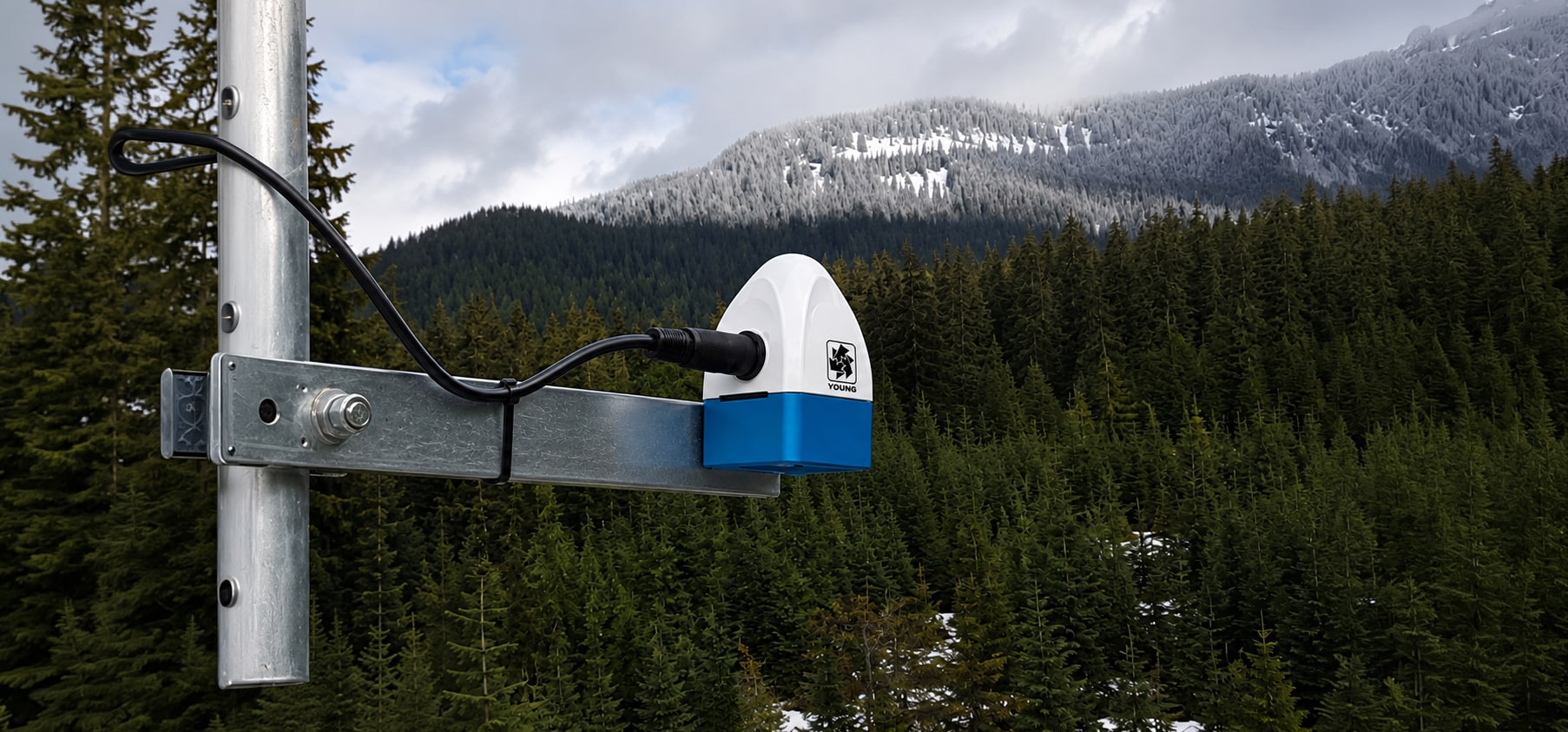
SNOdar is a compact LIDAR snow depth sensor engineered to deliver continuous, real-time measurements through active snowfall—when reliable data matters most.
ABOUT SNOdar
Snow depth data supports avalanche forecasts, road operations, water supply planning, and climate research. Most automated snow depth sensors rely on ultrasonic technology, which can lose signal quality in falling snow. That can create gaps in the record during the very events forecasters and operators need to track.
Unlike conventional ultrasonic sensors, SNOdar uses LIDAR to measure continuously through active snowfall. YOUNG engineered the sensor for the same ruggedness and long-term reliability that have defined our environmental instruments for more than 60 years.
PROVEN WHERE STORMS HIT HARDEST
“The number one thing SNOdar does for us is provide reliability during storms… SNOdar has far exceeded the reliability of other sensors we have used during storm periods.” – Andy Harrington, Avalanche Forecaster and Weather Station Lead, Northwest Avalanche Center
Avalanche Forecasting,
Cascade Mountains
The Northwest Avalanche Center relies on SNOdar across its network of 14 monitoring sites, where storm-period data drives real-time avalanche decisions.
Remote, Off-Grid Deployment,
Montana
The Gallatin National Forest Avalanche Center runs a standalone SNOdar site powered by a car battery and a small solar panel. The previous option was a game camera pointed at a snow stake.
Snow Research,
Western U.S.
Boise State University snow researchers use SNOdar to track both accumulation and melt across a multistate research network.
BENEFITS
Designed for dependable performance in demanding winter environments.
Measures Through Active Snowfall
LIDAR technology keeps measuring during heavy snowfall, helping reduce gaps when storm data matters most. An internal heater helps keep the lens clear in icing conditions.

Protects Your Data Record
SNOdar stores a full season of data internally, so measurements remain on the sensor even if an external logger, modem, or communication link goes down.
Designed for Remote, Off-Grid Sites
With typical seasonal power use averaging just 0.5 W on a 6 to 24 VDC input, SNOdar is well suited for solar- and battery-powered stations. Its IP67 enclosure and operating range are built for harsh environments.

Integrates with Existing Networks
Standard SDI-12 and RS-232 outputs connect with common data loggers, LTE modems, and satellite communications. Multiple sensors can also share a single SDI-12 bus.

Compact and Easy to Deploy
At just 265 g and smaller than a baseball, SNOdar mounts easily on standard towers and non-standard installations, including angles up to 30°. Bluetooth setup eliminates the need for a laptop or programming cable.
SPECIFICATIONS
The technical details behind reliable, season-long snow monitoring.
| Input Voltage: | Input voltage range (VDC): |
|---|---|
| Operating Temperature: | Outside, ambient operating temperature range: |
| Storage Temperature: | Inside, ambient storage temperature range: |
| Mechanical Vibration: | 20g MIL-STD-883D |
| Mechanical Shock: | 500g MIL-STD-883D |
| Ingress Protection: | IP67 |
| Corrosion Resistance: | Type II: MIL-A-8625 |
| Accuracy | ±1 cm to 2 m |
| Resolution: | 1 cm |
| Range: | 0.09 to 9 m |
| Measurement Interval: | 1 to 60 min |
| Current Consumption: | 0.04 to 0.26 amps |
| Power Consumption: | 0.42 to 3.24 watts |
| Average Power: | 0.5 watts |
| Weight: | Without bracket: 265 grams |
| Size: | 6.3 cm x 6.3 cm x 9.5 cm (W x L x H) |
| ESD Ratings | Human-Body Model: ±2500V |